The content in this page was adapted from the Long Term Ecological Research (LTER) Network’s course “Synthesis Skills for Early Career Researchers” (SSECR). Those materials can be found at lter.github.io/ssecr.
1 Overview
So, you’ve done the research. Great! Now it’s time to get the word out. Science communication is the final step in the synthesis science process. It lets your work grow to be as impactful as it can be. But it’s hard, especially for those without training in it. In this module, we’ll talk through some broadly applicable SciComm strategies that will get you started.
2 Why Communicate Your Findings?
“Science speaks for itself.”
“Good work will get recognized on its own.”
“It’s the journal/university/lab’s job to share my results.”
All of the above are common excuses that keep researchers from taking the initiative to communicate their science. But sharing your work is an essential part of maximizing its impact.
Some evidence (like this paper) shows that tweeting the results of a paper leads to more citations. Other studies disagree, but find that total engagement still increases when work is shared (from this paper). Engagement has rewards!
Putting your work out in public let’s others find it. That could lead to new collaborators, more citations, an article in the press, or even money from funders. If that work hides behind a paywall, it’s much harder for someone to find it!
Think about this–one Santa Barbara Coastal (SBC) LTER researcher was walking on the beach, doing drone surveys. Someone stopped to chat, and they explained their research to them. A few weeks later, the SBC LTER had three million more dollars, after that person decided to donate to the cause. All from SciComm!
Today, we’re going to walk through turning your own research into an elevator pitch, a tight, concise explanation of what you’ve done. The process of creating an elevator pitch will give you the tools necessary to adapt your message to a variety of different audiences and formats.
3 The Message Box
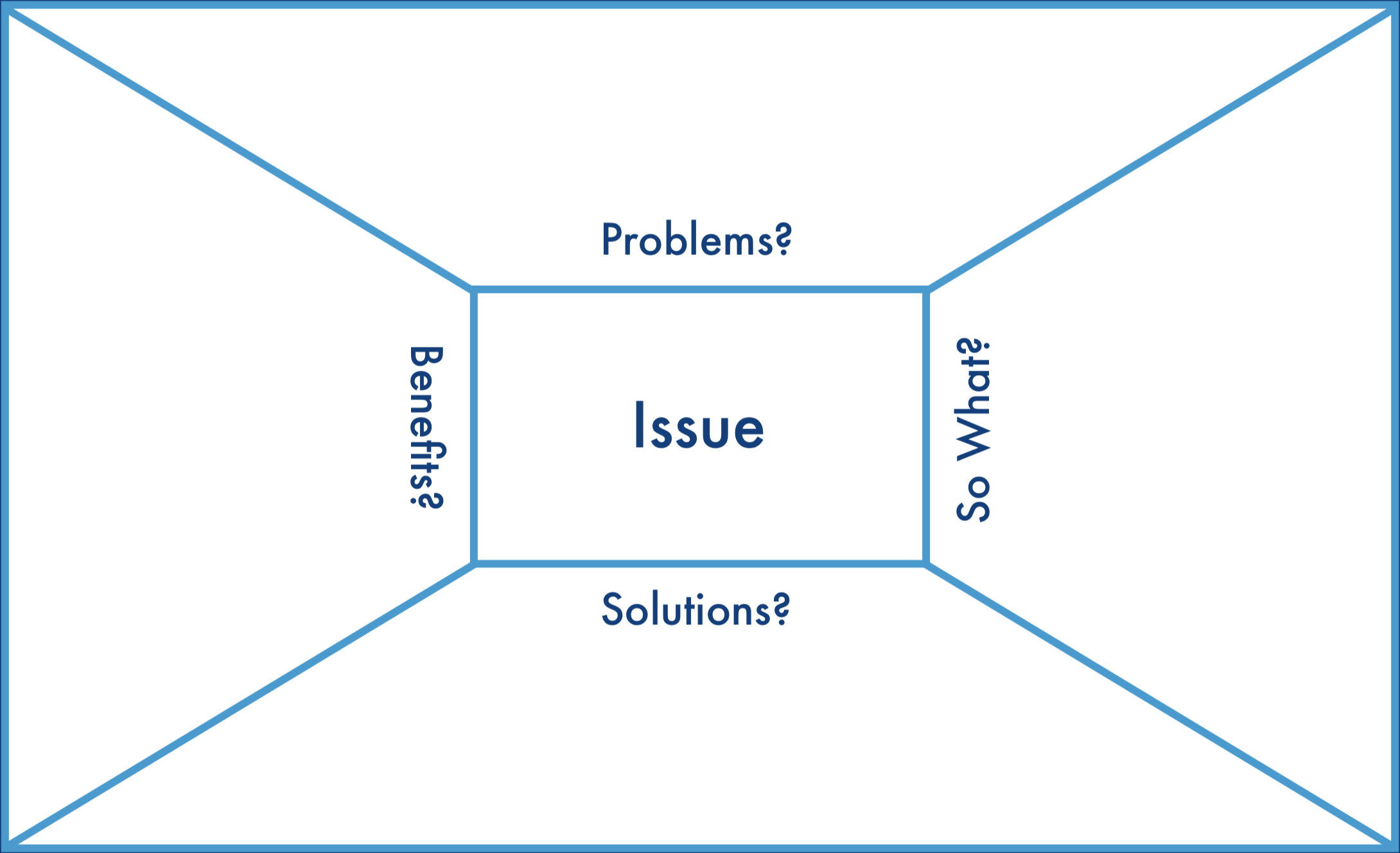
The Message Box is a tool that helps researchers take the information they hold about their research and communicate it in a way that resonates with the chosen audience. It can be used to help prepare for interviews with journalists or employers, plan for a presentation, outline a paper or lecture, prepare a grant proposal, or clearly, and with relevancy, communicate your work to others. While the message box can be used in all these ways, you must first identify the audience for your communication.
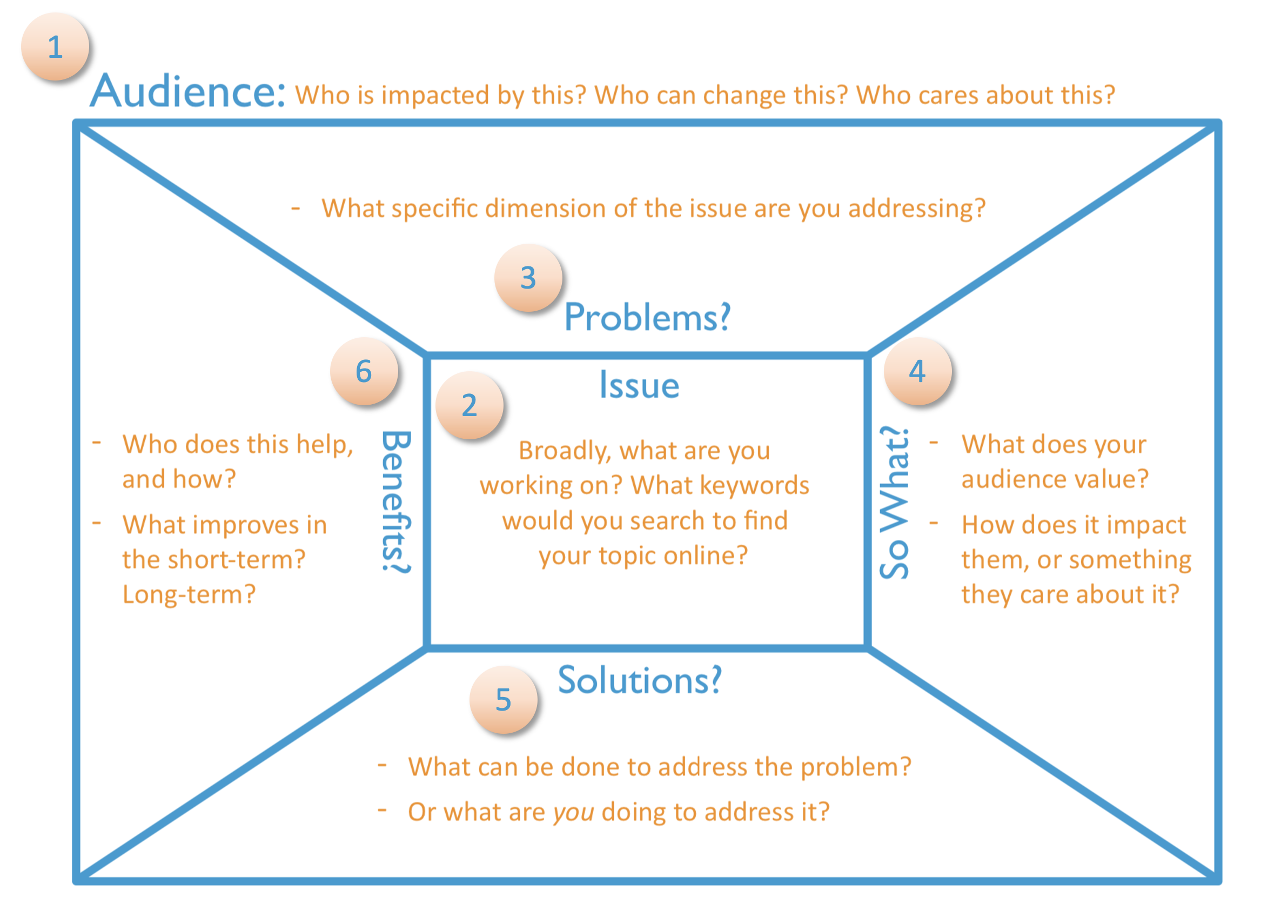
The Message Box comprises five sections to help you sort and distill your knowledge in a way that will resonate with your (chosen) audience. Click through the tabs below for more details on each.
The Issue section in the center of the box identifies and describes the overarching issue or topic that you’re addressing in broad terms. It’s the big-picture context of your work. This should be very concise and clear; no more than a short phrase. You might find you revisit the Issue after you’ve filled out your Message Box, to see if your thinking on the overarching topic has changed since you started.
- Describes the overarching issue or topic: Big Picture
- Broad enough to cover key points
- Specific enough to set up what’s to come
- Concise and clear
- ‘Frames’ the rest of the message box
The Problem is the chunk of the broader issue that you’re addressing in your area of expertise. It’s your piece of the pie, reflecting your work and expert knowledge. Think about your research questions and what aspect of the specific problem you’re addressing would matter to your audience. The Problem is also where you set up the So What and describe the situation you see and want to address.
- The part of the broader issue that your work is addressing
- Builds upon your work and expert knowledge
- Try to focus on one problem per audience
- Often the Problem is your research question
- This section sets you up for So What
The crux of the Message Box, and the critical question the COMPASS team seeks to help scientists answer, is “So what?” Why should your audience care? What about your research or work is important for them to know? Why are you talking to them about it?
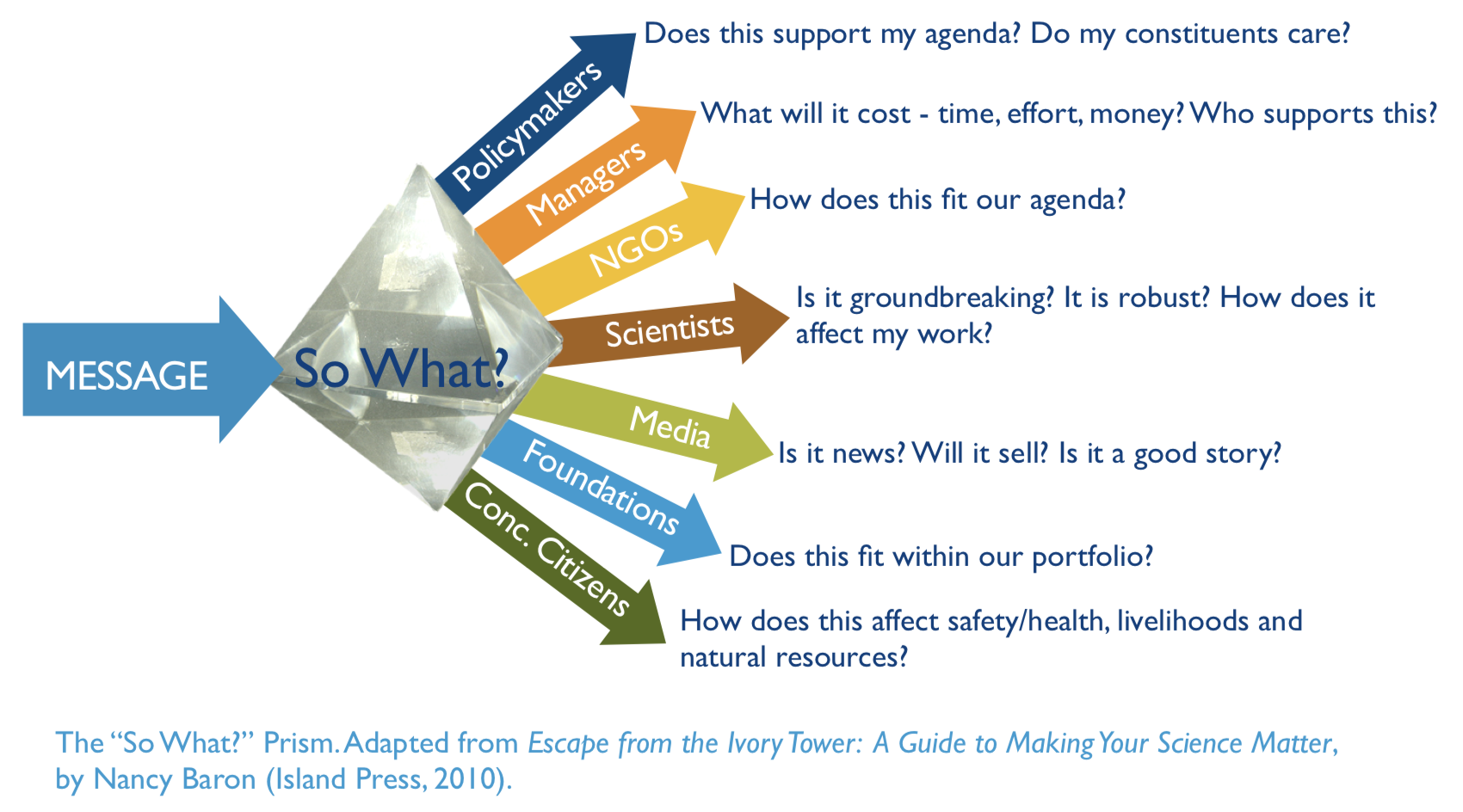
The answer to this question may change from audience to audience, and you’ll want to be able to adjust based on their interests and needs. We like to use the analogy of putting a message through a prism that clarifies the importance to different audiences. Each audience will be interested in different facets of your work, and you want your message to reflect their interests and accommodate their needs. The prism below includes a spectrum of audiences you might want to reach, and some of the questions they might have about your work.
- This is the crux of the message box
- Why should you audience care?
- What about your research is important for them to know?
- Why are you talking to them about it?
The Solution section outlines the options for solving the problem you identified. When presenting possible solutions, consider whether they are something your audience can influence or act upon. And remind yourself of your communication goals: Why are you communicating with this audience? What do you want to accomplish?
- Outlines the options for solving the Problem
- Can your audience influence or act upon this?
- There may be multiple solutions
- Make sure your Solution relates back to the Problem. Edit one or both as needed
In the Benefit section, you list the benefits of addressing the Problem–all the good things that could happen if your Solution section is implemented. This ties into the So What of why your audience cares, but focuses on the positive results of taking action (the So What may be a negative thing–for example, inaction could lead to consequences that your audience cares about). If possible, it can be helpful to be specific here; concrete examples are more compelling than abstract. Who is likely to benefit, and where, and when?
- What are the benefits of addressing the Problem?
- What good things come from implementing your Solution?
- Make sure it connects with your So What
- Benefits and So What may be similar
4 The Power of a Story
Read the two following introductions to an essay about wildfire. Which essay would you rather continue to read?
Climate change is affecting all ecosystems. One of the impacts from climate change is that wildfire intensity is increasing across the globe, including in the Boreal Forest. Wildfire releases carbon into the atmosphere and threatens local communities. Some researchers are working on wildfire mitigation strategies in Alaska.
The smoke is thick in Fairbanks. Air the characteristic dirty orange of a nearby wildfire. Michelle Mack, lead PI of the Bonanza Creek LTER and long-time fire ecologist, saunters out of her lab. “It’s gone,” she says. Overnight, the nearby McDonald Fire burned one of her experiments down. The experiment explored an innovative approach to preventing wildfires. Now it was charcoal. (from Shaped by fire: the Bonanza Creek LTER)
What are the differences here? Version 2 has tension, which begs for a resolution–the reader has incentive to keep reading. The second has characters, which can inspire empathy. There is a tangible sense of time, a before, during, and after. The language in Version 2 is more dynamic, less technical.
Version 2 has the makings of a story–a narrative with a beginning, middle, and end. It has characters. It has scenes. Those, in combination, do a better job of engaging an audience than just facts do. Storytelling is a central part of communication. That should include science communication!
Ok–not every elevator pitch needs to start with “Once upon a time…” But thinking about building some sort of story into your elevator pitch can dramatically improve it’s effectiveness.
As someone who’s conducting the research, you already have stories. In fact, doing research is trying to figure out what a very specific story is–pulling a narrative from raw data. The trick to science communication is finding a different story, or modifying your story, to appeal to different audiences. We’ll cover that below.
5 ‘And, But, Therefore’ Framework
The ‘And, But, Therefore’ (ABT) framework is a simple tool that helps develop a narrative in an elevator pitch (or any other short communication material). The temptation for many (researchers and non-researchers!) is to continue adding AND’s to their work.
Climate change is affecting all ecosystems. AND One of the impacts from climate change is that wildfire intensity is increasing across the globe, including in the Boreal Forest. AND Wildfire releases carbon into the atmosphere and threatens local communities.
But that doesn’t add up to any sort of great story, just a collection of facts. Scientific peers might know what to do with these facts (but…they still often don’t!), but most people don’t want to put in the effort to connect the dots.
The ‘And But Therefore’ framework provides a scaffolding from which to build a story.
This method really helps you focus in on just the critical parts of the story. There are many things that you’ll leave out. That’s more than OK–that’s the point! The first “and” is a setup–all your baseline information lives here. Let’s try this out with our Boreal forest research:
Spruce trees evolved to burn, AND as a result, wildfire is an important part of the Boreal forest ecosystem.
We’ve provided the bare minimum information for people to understand our research. But research addresses a problem. The “but” leads us to that problem:
BUT, climate change is making fires burn hotter and more frequently, and those fires are now beginning to threaten people who live near the Boreal forest.
Now, the audience knows the stakes, as well as the background. They want to know how that problem is being addressed! How will we protect those people that live near the Boreal?
THEREFORE lets you resolve the tension that was built by the BUT.
THEREFORE, researchers are designing fire mitigation strategies that protect these communities while simultaneously providing communities with spaces to farm or recreate.
All together, we get…
Spruce trees evolved to burn, AND as a result, wildfire is an important part of the boreal forest ecosystem. BUT, climate change is making fires burn hotter and more frequently, and those fires are now beginning to threaten people who live near the boreal forest. THEREFORE, researchers are designing fire mitigation strategies that protect these communities while simultaneously providing towns with spaces to farm or recreate.
Another example, on a completely different subject, we’ll be using this paper as an example: Using a units ontology to annotate pre-existing metadata | Scientific Data
Scientific data needs units–meters per second, grams, etc.–to have any real meaning, AND researchers might write those units in any number of different ways, even though they refer to the same thing (e.g., “meters per second” might be written “m/s”, or “m-s”, or “m per s”). BUT computers read those different annotations as unique, preventing easy analysis across different datasets. THEREFORE an LTER working group developed a tool that turns a mess of units into a standardized unit ontology, solving problems with this method.
6 Jargon
What is jargon? “Special words or expressions that are used by a particular profession or group and are difficult for others to understand,” as per the dictionary.
That’s not very useful. Let’s illustrate this better with an example:
UpGoer5 Graphic
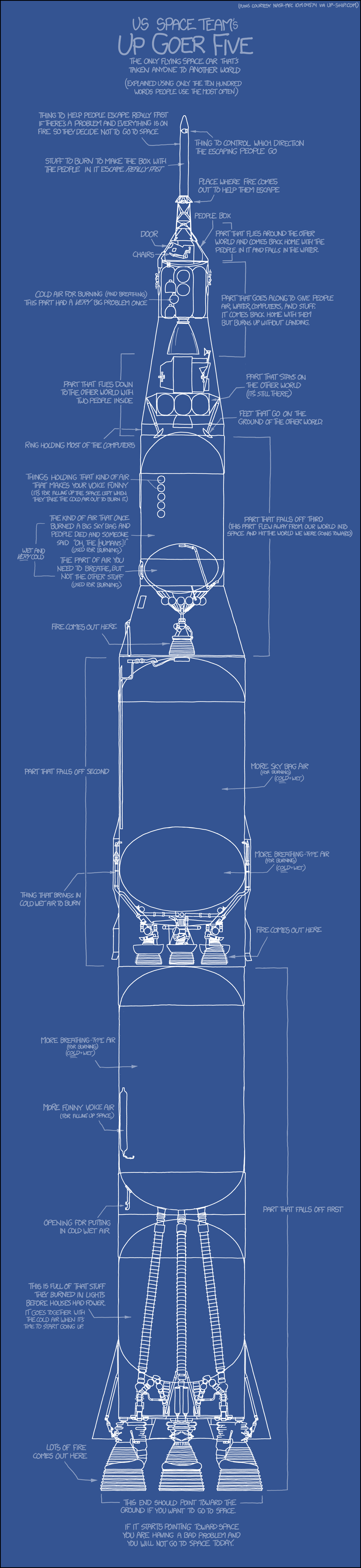
This is a rocket, that’s described only by the thousand (ten hundred) most common words in English. Kind of a mess, huh!
Remember our elevator pitch for scientific data?
Scientific data needs units–meters per second, grams, etc.–to have any real meaning, AND researchers might write those units in any number of different ways, even though they refer to the same thing [“meters per second” might be written “m/s”, or “m-s”, or “m per s”]. BUT computers read those different annotations as unique, preventing easy analysis across different datasets. THEREFORE, an LTER working group developed a tool that turns a mess of units into a standardized unit ontology, solving problems with this method.
Numbers only mean something if they have a word at the end that tells us what they mean. But people that study how the world works write what they mean in different ways. Computers read those things they write to mean something wrong. So people that try and make life easier for the people that study the world came up with a way to make those the way people write what they mean the same. That way, the people that study the world can work together, using computers, and everyone understands.
Whew! Looks like we needed some…jargon to make this a bit better!
6.1 We All Need Jargon
Jargon is useful! Terms that refer to highly specific things streamline our ability to communicate. Too little jargon is also a problem!
Jargon is a shared language used by an “in-group.” Some of that jargon is shared by a large in-group–maybe environmentally-minded people. But for scientific jargon? Most people are not part of that group! That’s important for communicating science–you need to use terms that the audience understands. Remember, each audience might understand different terms!
But Russel Hirst, who has a great lesson on jargon, captured this important consideration nicely:
Remember, though: when you are reducing jargon, you must not damage accuracy. For example, if you were to substitute “burnable” for “flammable,” you could be doing readers a great disservice; “flammable” has a specific meaning. A flammable substance (such as gasoline) is not merely burnable; it is very easily ignited, will ignite if a flame or spark merely touches its fumes, and it burns with great intensity. - Russel Hirst
6.2 But Jargon is a Double-Edged Sword
So…use jargon but don’t use it wrong? Yep!
You’re going to have to use jargon. You might find that you have to use jargon that nobody but you and your labmates will understand. When this happens, it is critical that you define those terms! Explain what you mean early, and continue to remind the audience what you mean throughout your talk/video/casual chat.
But we don’t want clunky writing! One great blog post makes a key distinction between jargon and another type of unapproachable writing: “sentence fat”.
Sentence fat is unnecessarily clunky words and phrases that make it unreasonably hard to understand. When we remove these clunky phrases, our writing gets much more streamlined and easier to understand.
Let’s take a look at some good examples.
We calculated the volume of water in the adjoining ocean to assist local homeowners with maritime ecosystems as neighbors
Trimmed Version
We studied sea level to protect coastal communities.We present materials, mechanics, and integration schemes that afford scalable pathways to working arthropod-inspired cameras with nearly full hemispherical shapes.
Trimmed Version
New, high-tech digital cameras mimic bug eyes.This system works because of AI integration through motion scaling and tremor reduction.
Trimmed Version
This system works because of programming that makes the robot’s movements more precise and less shaky.Translate communication into various formats based on efficacy with target group
Trimmed Version
Adapt communication to fit different audiences7 Adapting Your Message to Different Audiences
You’re 17, back in high school. The football team had a party last night, and you and all your friends went. Describe the party to…
…who was grounded and couldn’t go:
“It was crazy. Jackie jumped off the roof into the pool!”
…who was hesitant to let you go:
“It was fun! Low key. Jackie was there–from soccer!”
Neither of these stories are false–but they’re narratives that are designed to best appeal to their target audience. Effective science communication does the same thing: it organizes its narrative around the ideas that best appeal to specific groups. Figuring out which story best appeals to specific audiences is the key to mastering effective science communication.
From Northeastern’s Tips for Effective SciComm:
Caution: who the heck is the “general public?”. Wants to know how your research impacts their lives and their societies. This communication could take the form of a formal presentation, or it could be a casual conversation with friends and neighbors.
Wants to know what makes the findings of your research important, including how it’s different from what others have done
Want to know whether your work will provide them with a significant return
Will be interested in determining whether your work may provide an opportunity for future collaboration, or how it ties into their own work
Need to know if a project has achieved the expected results and should progress to the next phase, or if changes are needed
Each of these audiences is looking for something different–they have different motivations and needs. You first need to understand what they’re looking for. Then, you can identify which stories will best address those needs.
Here are some things that differ between audiences:
- Knowledge of the issue
- How that issue affects them
- Values they hold
- What captures their attention
The first step is to try and understand the audience you’re writing for.
A funder familiar with the work won’t need you to tell them that climate change is a serious problem, but an eighth grader might! Or, if you’re posting a video on YouTube, you need to hook that audience in–finding something that’s interesting is paramount. That’s not as essential in a poster session or thesis defense!
Remember our elevator pitch? Thinking about audience should be second, after you identify your core story.
Note: “The general public” is not an audience! The public is not very general. Every subgroup has different motivations
Let’s try to adapt our example elevator pitch to two different audiences:
Spruce trees evolved to burn, AND as a result, wildfire is an important part of the boreal forest ecosystem. BUT, climate change is making fires burn hotter and more frequently, and those fires are now beginning to threaten people who live near the boreal forest. THEREFORE, researchers are designing fire mitigation strategies that protect these communities while simultaneously providing towns with spaces to farm or recreate.
A lot of people in Alaska are threatened by fire every summer, and instead of trying to put out every fire, they instead focus on stopping fires before they get to towns. They usually cut strips out of the forest around towns, but that’s kind of ugly and bad for the ecosystem. So instead, people are trying to figure out what they can do in those clear cuts! Some projects are growing berries, others put in aircraft landing strips or parks. Basically, if they’re going to cut those trees down anyways, it’s better to have some sort of useful space, rather than just empty land.
Fuel breaks are necessary for mitigating fire risk to local communities in Alaska. But fuel breaks are disruptive to the ecosystem, ugly to look at, and provide little to no value to local communities outside of mitigating fire risk. This project re-imagines fuel breaks to maximize benefits to local communities by providing space for parks, food production, or industry while maintaining their effectiveness as a fire mitigation strategy.