After completing this session, you will be able to:
- Articulate some of the main challenges around equitable intellectual credit
- Identify some ways in which synthesis-focused intellectual credit conversations may differ from non-synthesis projects
- Describe some common frameworks for equitable authorship decisions
- Define some advantages and disadvantages of “opt-in” and “opt-out” approaches to authorship
- Explain benefits (or avoided costs) of making authorship decisions both collaboratively and transparently
- Discuss the shifting context around modern authorship conversations
Parts of the content in this page were adapted from the Long Term Ecological Research (LTER) Network’s course “Synthesis Skills for Early Career Researchers” (SSECR). Those materials can be found at lter.github.io/ssecr
Intellectual Credit Context
Navigating issues of intellectual property and credit can be a challenge, particularly for early career researchers. Open communication is critical to avoiding misunderstandings and conflicts. Talk to your collaborators about credit early and often to avoid hurt feelings and keep your team functioning smoothly. This is particularly important when working with new collaborators and across lab groups or disciplines which may have divergent views on what constitutes appropriate credit for a given product. If you feel uncomfortable talking about issues surrounding credit or intellectual property, seek the advice or assistance of a mentor to support you in having these important conversations.
Credit & Authorship
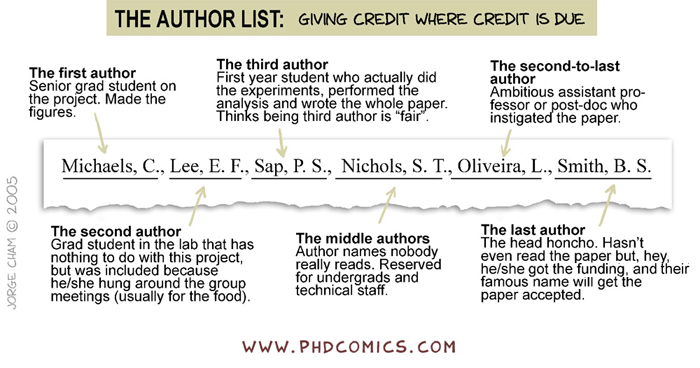
For those with an academic background, it can be easiest to think about intellectual credit in terms of inclusion as a co-author on a peer-reviewed paper. Author order can also be hugely significant–though the prestige of particular positions in the author order can differ wildly between disciplines. For the purposes of this training, we’ll use authorship as a framing device for a larger conversation about intellectual credit. That does not mean that intellectual credit begins and ends at an authorship policy but it is a useful lens through which we can examine some common examples and issues with intellectual credit more broadly.
Regardless of the context, if your team builds a shared understanding of intellectual credit early in your process and navigates those conversations with empathy and intentionality, things will likely turn out all right!
In pairs, discuss (some of) the following:
- What types of non-paper products do you think warrant formal credit?
- How–in your opinion–should that credit be granted?
- What type of credit is the most impactful for your career right now?
- Has that changed over time?
- If so, how?
- Other than degree of contribution, what other factors affect how much credit you feel someone deserves on a given project?
- For example, to what extent does the perceived (or actual) career benefit to someone supersede their contribution when allocating formal credit?
Authorship Policy Examples
It can be hlpeful to start by considering some examples of intellectual credit frameworks. Click through the tabs below for some highlights of a few examples.
The Ecological Society of America (ESA) created a Code of Ethics with some guidance for publication co-authorship as part of it. ESA suggests that reserachers claim authorship only if they have made a “substantial contribution” to the work.
This must at least include one of the following:
- conceived the ideas or experimental design
- participated actively in execution of the study
- analyzed and interpreted the data
- wrote the manuscript
ESA’s authorship policy also prevents researchers from adding/deleting authors without those individuals’ consent–both in terms of their inclusion as authors and their agreement with the final version of the manuscript.
The International Committee of Medical Journal Editors (ICMJE) also has some guidelines for conduct, reporting, editing, and publishing scholarly work which includes some facets of intellectual credit/authorship. The ICMJE actually provides a slightly stricter framework for intellectual credit than ESA’s guidelines.
Collaborators must do all of the following to warrant authorship:
- Substantial contributions to the conception or design of the work; or the acquisition, analysis, or interpretation of data for the work
- Drafting the work or reviewing it critically for important intellectual content
- Final approval of the version to be published
- Agreement to be accountable for all aspects of the work in ensuring that questions related to the accuracy or integrity of any part of the work are appropriately investigated and resolved
The Contributor Role Taxonomy (CRediT) separates research roles into 14 categories though doesn’t necessarily identify how performing those duties relates to authorship. Many teams that adopt this framework decide on some critical number of categories that a team member must fulfill in order to warrant authorship.
For teams that adopt this framework, a common convention is to create a shared spreadsheet with one row per collaborator with a column for each of the CRediT roles. Each collaborator simply marks an “X” in each column for which they feel they’ve contributed. Such a spreadsheet can also be a useful place to aggregate affiliation information as well!
The CRediT roles are recapitulated in the table below.
| Conceptualization |
Ideas; formulation or evolution of overarching research goals and aims |
| Data Curation |
Management activities to annotate (produce metadata), scrub data and maintain research data (including software code, where it is necessary for interpreting the data itself) for initial use and later re-use |
| Formal Analysis |
Application of formal statistical, mathematical, computational, or other formal techniques to analyze or synthesize study data |
| Funding Acquisition |
Acquisition of the financial support for the project leading to this publication |
| Investigation |
Conducting a research and investigation process, specifically performing the experiments, or data/evidence collection |
| Methodology |
Development or design of methodology; creation of models |
| Project Administration |
Management and coordination responsibility for the research activity planning and execution. |
| Resources |
Provision of study materials, reagents, materials, patients, laboratory samples, animals, instrumentation, computing resources, or other analysis tools |
| Software |
Programming, software development; designing computer programs; implementation of the computer code and supporting algorithms; testing of existing code components |
| Supervision |
Oversight and leadership responsibility for the research activity planning and execution, including mentorship external to the core team |
| Validation |
Verification, whether as a part of the activity or separate, of the overall replication/reproducibility of results/experiments and other research outputs |
| Visualization |
Preparation, creation and/or presentation of the published work, specifically visualization/data presentation |
| Writing - Original Draft |
Preparation, creation and/or presentation of the published work, specifically writing the initial draft (including substantive translation) |
| Writing - Review & Editing |
Preparation, creation and/or presentation of the published work by those from the original research group, specifically critical review, commentary or revision–including pre- or post-publication stages |
Credit & Perception of Contribution
Keep in mind that intellectual credit is both grounded in tangible contributions to a project and our perception of those efforts. It is quite common for individuals to overestimate their own contribution to the work of a team, especially when the outcome is positive.
A research team formally examined the phenomenon in the context of scientific publishing and found that authors almost universally over-estimated their own contribution to a project, at least with respect to how their team members perceived it (Herz et al. 2020).
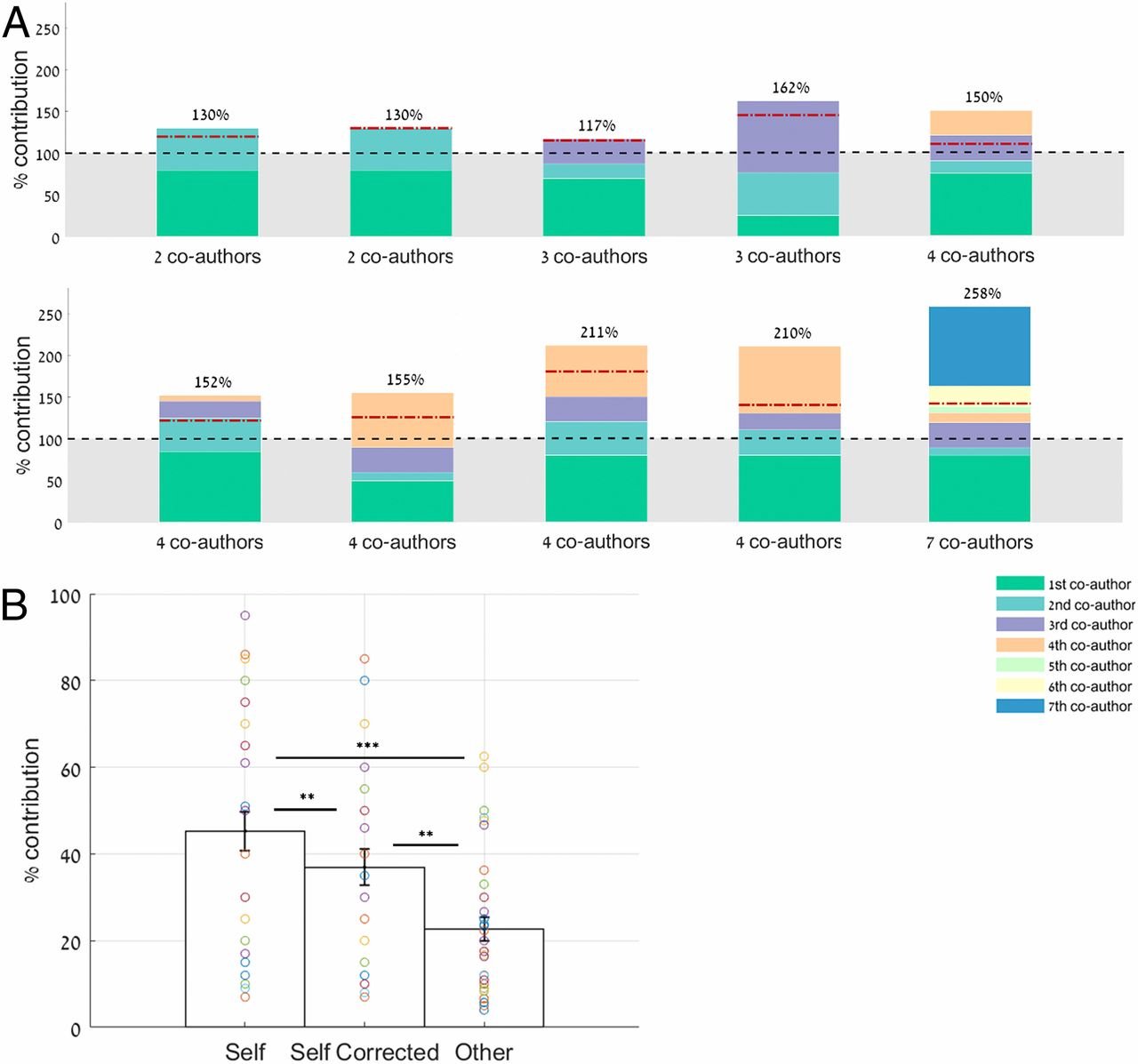 Figure taken from (Herz et al. 2020). The sum of coauthors percent contribution to 10 published manuscripts is shown in (A). The red dash-dotted line represents the sum of coauthors’ contributions after they were given the opportunity to adjust their own percent contribution. In (B) we show the mean percent contribution assigned by coauthors to themselves in Step 1 (“Self”), percent contribution coauthors assigned to themselves after given the opportunity to adjust their contribution not to exceed 100% in Step 2 (“Self-Corrected”), and mean percent contribution assigned to authors by their coauthors (“Other”). Error bars represent standard errors of the means. **p<.01, ***p<.0001.
At each stage of a project, different factors may work to distort, conceal, or amplify the contributions of some authors or potential authors. Let’s take a few minutes to consider some project stages and how misperceptions might arise.
- In group discussions, the contributions of asynchronous or virtual participants can easily be discounted, because they seem less immediate.
- Similarly, when an idea is first contributed by an early career-stage participant, it can be overlooked until echoed by a senior participant.
- Often, a seemingly naive question ignites the process that leads to a new way of seeing the problem. In these cases, the conclusion is often remembered, but the question (and the questioner) rarely is
- Data that are easily accessed and downloaded can receive less credit than when the synthesis team needs to make direct contact with the original researcher to get access or permission to use. Data should always be cited, even when they are already publicly available
- Significant labor goes into finding, downloading, and cleaning datasets, but it is not glamorous work and often happens in isolation. That does not make it any less essential
- Data analysis is the “meat” of synthesis, but even here there are pitfalls. Consider the originality of the approach and the labor involved when valuing analytical contributions
- While the work of doing the analysis may fall to the more quantitatively skilled team members, key insights at this stage often come from careful review by, and discussion with, field ecologists and savvy communicators. Just because someone didn’t write the R code doesn’t mean they didn’t contribute to analysis
- Like framing a house, framing the “story” of a paper provides essential structure and stability – even when covered by the walls and trim (or words and figures) of the built-out product.
- Getting the first few paragraphs on the page is a valuable contribution – even if not a single one of those words makes it to the final draft. Editing and expanding others’ work is far easier than writing de novo
- Even when all contributors are fluent writers, the job of merging disparate sections into a single voice is challenging and deserves credit
- Resolving versions, checking references, and formatting are thankless, but essential tasks in getting to a publishable product
Opt-In v. Opt-Out Authorship
There are two major ways to approach authorship, whether you’re talking about papers, derived data, or software: the default position can be that no one is an author unless they opt-in, or everyone is an author unless they opt-out.
- Opt-in approaches require individuals to be invited to or request involvement in a product and set basic criteria for authorship.
- Opt-out approaches assume that anyone contributing data, or making contributions to, say, the GitHub repository behind a package, will be credited as an author.
Some collaboration efforts use a hybrid system, where the primary paper issuing from a data assembly effort is expected to use an opt-out model (and therefore includes all the data contributors), while subsequent papers require potential authors to opt-in and participate in developing the analysis and writing the paper.
Note too that journals generally require that all authors explicitly acknowledge their authorship. So even if you have an opt-out model, if a coauthor doesn’t explicitly agree to be listed–which can be done by simply adding their name and affiliation to a spreadsheet–they must be excluded.
As researchers, we can be reluctant to opt-out of a paper for many reasons. We “should” have time. We need the paper for our CV. Or we are just embarrassed to have misjudged our own capacity to contribute. If you find that you can’t contribute at a level that warrants authorship, the kindest thing you can do for your co-authors is to opt out.
Authorship is also not the only way to recognize contributors. When funding is the only contribution to the research, funders should appear in the acknowledgments section. Other contributions, such as translation, line editing, acquisition of permits, or other logistical support are also appropriate for the acknowledgments section, when the relevant individuals have not also contributed to developing the study and writing the paper. Data providers who have not contributed to study design should be credited by citing their data, in the references using a DOI and appropriate bibliographic information.
How to Develop and Use an Authorship Policy
An authorship policy will be most helpful if it if it reflects shared values of the research team and is developed before conflicts arise.
Oliver et al. (2018) described six principles that they aimed for their authorship process to support:
- Transparency
- Inclusion & Fairness
- Protection & Promotion
- Accountability
- Efficiency & Productivity
- Creativity
Oliver et al. then identified a set of ordered, but inter-related best practices that fit within their six guiding principles. Their approach considers the entire life of a project and aims to balance efficiency, creativity, and inclusion – which can seem to be in conflict. It would, for example, be very inefficient to solicit many authors for a student’s dissertation paper, which is likely to only involve a small number of authors in the end. Consider the tabs below for more details.
Their starting point is to understand the makeup of the group involved. What are each member’s assumptions about authorship credit and order? These can differ based on their field of study, their country of origin, their seniority, and their role in the group and what they hope to get out of involvement with the group. Articulating these assumptions at the start can avoid later conflicts.
Then develop a draft authorship policy - either from scratch or starting with one the many frameworks available. Recognize that this policy is a living document that the team can adjust as issues arise.
Announcing ideas that may lead to manuscripts is also critical in their view. It allows the whole team to contribute to developing the idea (creativity) and allows interested parties to opt-in to further development (transparency) and work on the project. Note that Oliver et al. were identifying their best practices from an academic perspective (2018) but this step is also applicable to non-manuscript products.
Determine the manuscript type. They outline a taxonomy of manuscript types, which will often determine how large the co-author list can or should be and what kinds of co-author management strategies will work best.
Disciplinary research manuscripts. Typical small-group papers. Clarity is required, but no additional special considerations.
Multidisciplinary research manuscripts. Special considerations include the unfamiliarity of researchers from one discipline with the work of the other and the role of data analysts.
Essay, commentary, or concept manuscripts. In these “idea papers” contributions may be less clearly delineated and harder to document.
Data manuscripts and database documentation. Data papers often use an opt-out model, where all group participants are included unless they are unable or unwilling to make basic contributions, such as editing or reading and approving the manuscript before submission. This is a convenient way to make sure that all contributors receive credit in at least one publication.
Graduate student dissertation manuscripts. Depending on the student’s institution and committee, this may require the involvement of fewer authors.
The decision on an authorship management strategy will flow from the type of paper and the individuals involved. Here, the value of flexibility and communication within the team is key.
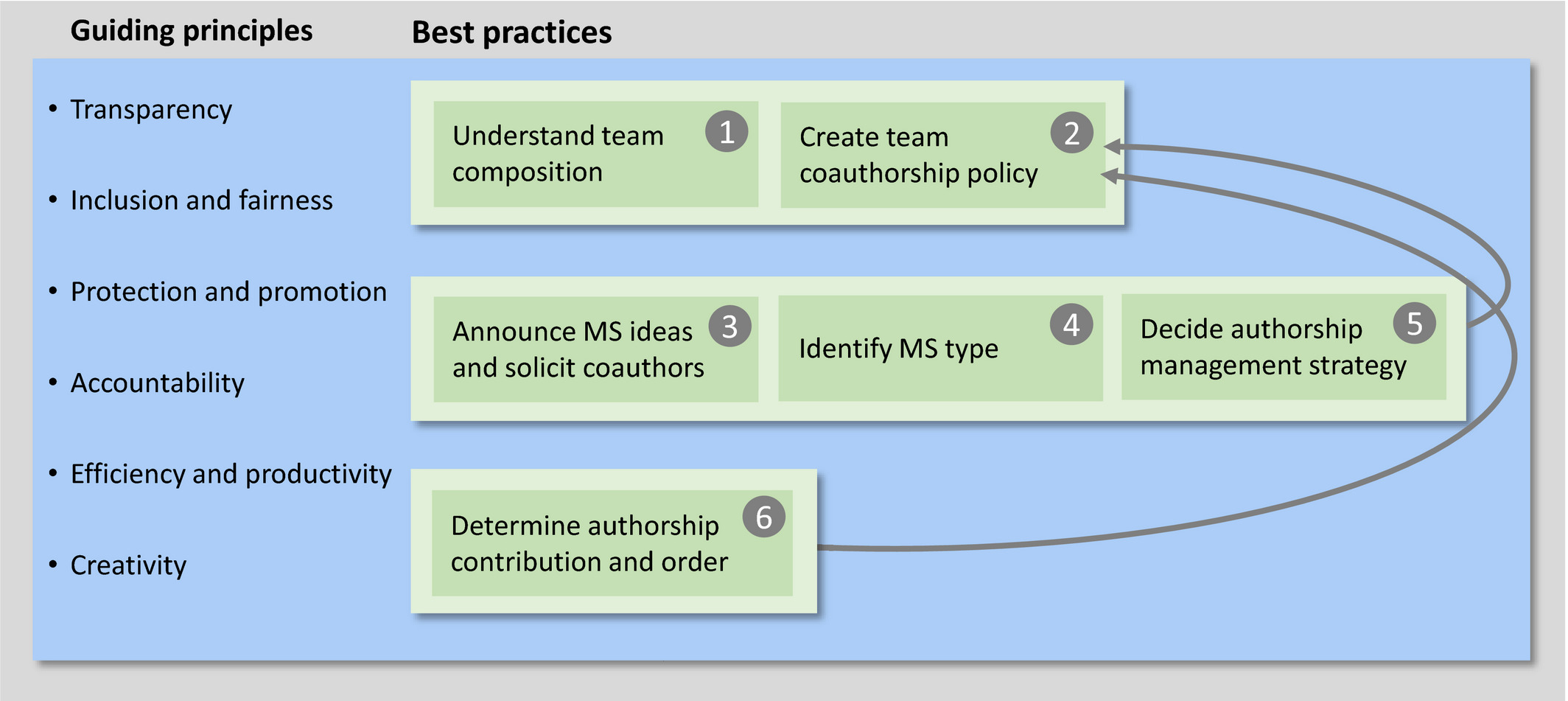 Figure taken from (Oliver et al. 2018). A conceptual diagram that shows the strategies for effective collaborative manuscript (MS) development being firmly embedded within and balancing the guiding principles, and the relative order that the practices occur (numbers). Strategies that are on the same row are strongly related, can occur in any order, and are in fact iterative. All strategies should feed back into the team coauthorship policy for evaluation and reflection about whether the practices are fulfilling the guiding principles
An Evolving Landscape
There are a number of ways in which the academic norms of intellectual credit either do not seem to apply or have been–rightly–challenged. Shifting these kinds of norms is rarely a quick process but is something that teams developing credit policies should consider from the outset of their respective projects; particularly when the project’s members, audience, or methdologies intersect with one of these novel frontiers.
Community science and knowledge co-production with non-academics, particularly Indigenous knowledge and rights-holders, have been growing rapidly in the last few years. The academic community is still struggling to come to terms with how best to honor and credit such research partners. Authorship is an academic currency that may or may not have value for community partners. Indigenous Peoples can be understandably wary about sharing data related to their land, resources, history, culture, and bodies.
The CARE Principles (Collective Benefit, Authority to Control, Responsibility, and Ethics) (Carroll et al. 2020) were published in 2020 help researchers focus on the values most important to Indigenous data stewards, rather than focusing solely on the open-data FAIR Principles (Findable Accessible, Interoperable, and Reproducible) (Wilkinson et al. 2016) and concrete guidance (Jennings et al. 2025) is gradually being developed to guide researchers. Community science and Indigenous data found in repositories should include guidance on how they can ethically be reused.
Another emerging issue in intellectual credit is how to deal with the growing role of AI in research and publishing. Understanding how AI has been used in a research effort is critical to evaluating the reliability of results and the intellectual contributions of each author. Providing figures and asking AI to write a paper yields a very different result than providing bullet points along with the figures, or asking AI to clean up your first draft.
In addition, almost every AI system currently available provides results by drawing on millions of public data sources, without any thought of crediting the originators. Journal publishers are starting to provide guidance (Lund and Naheem 2024) about how to acknowledge researchers’ use of AI but this guidance is still somewhat fluid and can vary between journals.
We contend that there is no single “right” authorship policy. But each policy we’ve covered has advantages in certain situations. What matters most is that the research team discusses their approach and records it in an accessible location where it can be revisited and updated as needed.
Let’s take a closer look at some approaches to authorship policies from teams of varying sizes. Each breakout group will focus on one policy and report back on their approach’s strengths and weaknesses.
- Nutrient Network Authorship Policy
- Expanded Authorship Guidelines (Cooke et al. 2021)
- CReDiT Framework (Brand et al. 2015)
- Arctic Data Center (ADC) Template
Note that we’ve selected these policies as they represent a breadth of approaches rather than because they are an exhaustive list (they are not).
On your own:
- Scan the assigned authorship policy
- Pay particular attention to:
- What kinds of contributions it effectively captures and credits
- Whether it misses certain kinds of intellectual contributions
- How it might distort or align incentives for collaboration, data sharing, and “freeloading”
- What elements feel like a particularly good (or bad) fit for your project team
With others who reviewed the same authorship policy, discuss your main take-aways from your solo review of the policy.
In your project teams (not your breakout groups), begin to build out your own authorship approach. Remember that even if you “finish” this today, the document should be a living one that you feel confident that you could revisit and revise should circumstances change! Here are a few key questions to get you started:
- How will you let participants know about papers and products?
- Beyond your core group, have others been involved or are likely to become involved in ways that might warrant intellectual credit?
- How will they learn about upcoming products?
- Do you want to operate on an opt-in or an opt-out basis?
- What kinds of products do you expect to produce?
- What kinds of contributions do you think are most important?
- What is the minimum requirement for being a paper author? A dataset author? A package creator?
- How will you decide authorship order?
- In what other ways will you acknowledge contributions and extend credit to collaborators?
- How will you resolve conflicts if (when) they arise?
References
Brand, Amy, Liz Allen, Micah Altman, Marjorie Hlava, and Jo Scott. 2015.
“Beyond Authorship: Attribution, Contribution, Collaboration, and Credit.” Learned Publishing 28 (2): 151–55.
https://doi.org/10.1087/20150211.
Carroll, Stephanie Russo, Ibrahim Garba, Oscar L. Figueroa-Rodríguez, et al. 2020.
“The CARE Principles for Indigenous Data Governance.” Data Science Journal 19 (1).
https://doi.org/10.5334/dsj-2020-043.
Cooke, Steven J., Vivian M. Nguyen, Nathan Young, et al. 2021.
“Contemporary Authorship Guidelines Fail to Recognize Diverse Contributions in Conservation Science Research.” Ecological Solutions and Evidence 2 (2): e12060.
https://doi.org/10.1002/2688-8319.12060.
Herz, Noa, Orrie Dan, Nitzan Censor, and Yair Bar-Haim. 2020.
“Authors Overestimate Their Contribution to Scientific Work, Demonstrating a Strong Bias.” Proceedings of the National Academy of Sciences 117 (12): 6282–85.
https://doi.org/10.1073/pnas.2003500117.
Jennings, Lydia, Katherine Jones, Riley Taitingfong, et al. 2025.
“Governance of Indigenous Data in Open Earth Systems Science.” Nature Communications 16 (1): 572.
https://doi.org/10.1038/s41467-024-53480-2.
Lund, Brady D., and K.t. Naheem. 2024.
“Can ChatGPT Be an Author? A Study of Artificial Intelligence Authorship Policies in Top Academic Journals.” Learned Publishing 37 (1): 13–21.
https://doi.org/10.1002/leap.1582.
Oliver, Samantha K., C. Emi Fergus, Nicholas K. Skaff, et al. 2018.
“Strategies for Effective Collaborative Manuscript Development in Interdisciplinary Science Teams.” Ecosphere 9 (4): e02206.
https://doi.org/10.1002/ecs2.2206.
Wilkinson, Mark D., Michel Dumontier, IJsbrand Jan Aalbersberg, et al. 2016.
“The FAIR Guiding Principles for Scientific Data Management and Stewardship.” Scientific Data 3 (1): 160018.
https://doi.org/10.1038/sdata.2016.18.